The quilt: its history and uses
Are you thinking about treating yourself to a beautiful quilt but would like to know more about its history and different uses? Heating qualities and technical details: Embrin answers all your questions.
The history of the quilt: a precious heritage
Born in the 12th century, the quilt tells a story of craftsmanship and passion. Its name, from the Old French “coute” (feather bed) and “poindre” (to prick), reflects its very nature: a soft, stitched cover and a true cocoon of warmth.
Originally handmade, the quilt was a precious treasure passed down from generation to generation. Today, it has lost none of its charm or value. Heir to a rich tradition, it comes in a variety of styles, adapting to everyone’s tastes and wishes. Thanks to their fine materials and artisan making, Embrin quilts are made to last: they will stand the test of time and make the ideal gift for young people as they set out on their own.
A unique decorative piece, it will bring a warm and peaceful atmosphere to your bedroom.
The quilt at home
A unique decorative piece, the quilt will bring a warm and peaceful atmosphere to your bedroom.
Warmth and loft: the gentle embrace of the quilt
Like a soft cloud, the quilt will envelop you with its plush thickness. Filled with 50% merino wool and 50% polyester, it instantly warms and invites you to relax.
Merino wool, known for its thermoregulatory properties, provides warmth and comfort every night of the year. Polyester, meanwhile, gives the quilt its loft and durability.
The combination of these two materials creates a unique experience of comfort and wellbeing. Snuggling under a quilt is like sinking into a cocoon of warmth and softness.
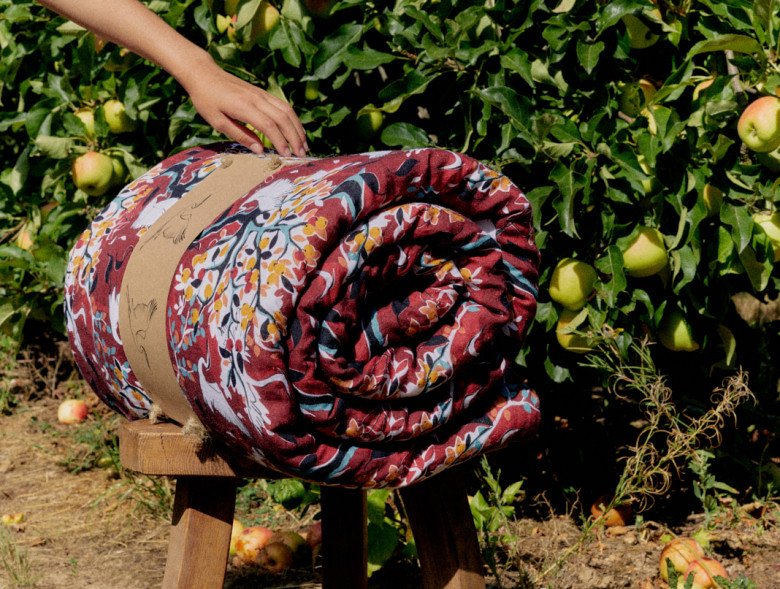
Let yourself be carried away by the soft and enveloping sensation of the quilt, and treat yourself to a peaceful and restorative sleep.
Can you use a quilt all year round?
The quilt is not just for keeping sleepers warm in winter, it can be used all year round.
Merino wool is a natural fibre able to work with air and moisture to offer unique properties. In winter, it traps the body’s warm air and returns it to the sleeper during the night. In summer, it can absorb up to 30% of its weight in water before feeling damp. Finally, merino wool is very breathable and allows air to circulate, helping the body’s thermoregulation.
Where should you place the quilt on the bed?
The quilt is often placed at the foot of the bed, like an eiderdown. But in fact, you can place it wherever you like, for example along the bed in place of the sleeper or sleepers. It can also be left folded during the day, or casually draped over the edge of the bed.
The quilt, a true decorative feature
Where else can you place the quilt in the home?
The quilt also has its place in the living room, on sofas and armchairs for example; but also in the garden, on the terrace for summer evenings, or even in the hallway, on a bench.
The quilt and its counterparts
The quilt is a warm, padded bedding item, useful in all seasons and in every room of the house. It is used for warmth and for covering up. While decorative, it is also thermoregulatory and proves indispensable whenever there’s a slight chill.
What is the difference between a quilt and an eiderdown?
The quilt is thinner than an eiderdown, which is filled with down. It is therefore less warm and ideal for all seasons, unlike the eiderdown which is only suitable for cold winter nights. It is also more versatile and less delicate, so it can be used in the bedroom, elsewhere in the house, and even outdoors in summer.
What is the difference between a quilt and a bed runner?
The bed runner is purely decorative. Unlike the quilt, it has no thermoregulatory properties and simply decorates the foot of the bed. It is very thin and has no padding.
In fact, the bed runner is usually put away at night and placed back each morning after making the bed. The quilt is designed to envelop us in gentle warmth every night, all year round; it is not just a decorative fabric.
What is the difference between a quilt and a bedspread?
The bedspread is a large piece of fabric designed to cover the whole bed. However, like the bed runner, it has no thermoregulatory properties: it remains thin and unpadded, and is purely ornamental.
What is the difference between a quilt and a duvet?
The duvet is an integral part of traditional bedding (pillow, mattress and duvet), while the quilt is an extra layer to keep the sleeper warm. The quilt was especially used in the past in homes without central heating. Thanks to its thickness, it allowed the use of ad hoc methods to warm the bed: bed warmers and foot warmers in particular (these wrought iron accessories contained hot embers to heat beds during winter).
Today, the quilt is less commonly used but is making a comeback in bedrooms thanks to eco-friendly measures adopted by households, such as reducing night-time heating.
In practice, the quilt is placed on top of the duvet, at the foot of the bed, and provides an extra source of warmth. The quilt, much warmer than a duvet, is mainly used during the cold nights of autumn and winter.
What is the difference between a quilt and a boutis?
The quilt is padded, soft and filled with wadding, whereas the boutis is simply quilted and intended for a purely decorative effect. The boutis has a rather traditional style with a specific pattern: Embrin quilts, on the other hand, feature unique and exclusive prints inspired by beautiful Normandy.