
Our Environmental Impact
We have carried out a full measurement of our environmental footprint with the consultancy La Belle Empreinte, specialists in life cycle analysis (LCA) for textile products.
This approach allows us to precisely understand the impact of our collections, from flax cultivation to the end of the product’s life, including all transformation stages. It then enables us to identify concrete levers for reducing our emissions and preserving natural resources.
Our goal: to design home linen that is both beautiful, durable, and environmentally friendly, based on verified data and complete transparency with our customers.
Why publish our footprint?
At Embrin, we believe transparency is the foundation of trust. This page brings together our key indicators, calculation method, and reduction roadmap. It will be updated as our practices evolve.
Results overview: footprint of an EMBRIN duvet cover
Impact on greenhouse gas emissions
Our measurements, carried out with La Belle Empreinte, highlight the real impact of our products.
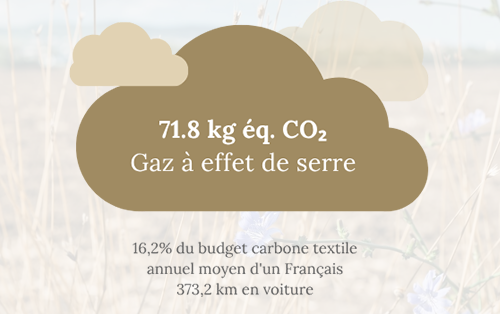
Over its entire life cycle, an Embrin linen duvet cover emits 71.8 kg CO₂ equivalent.
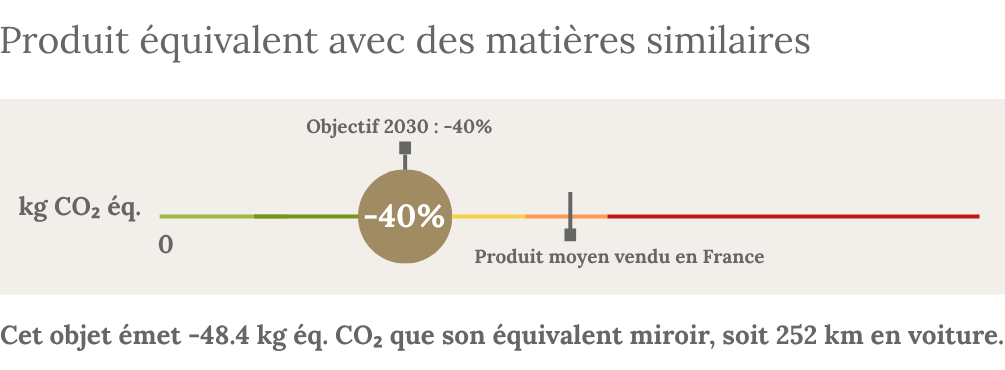
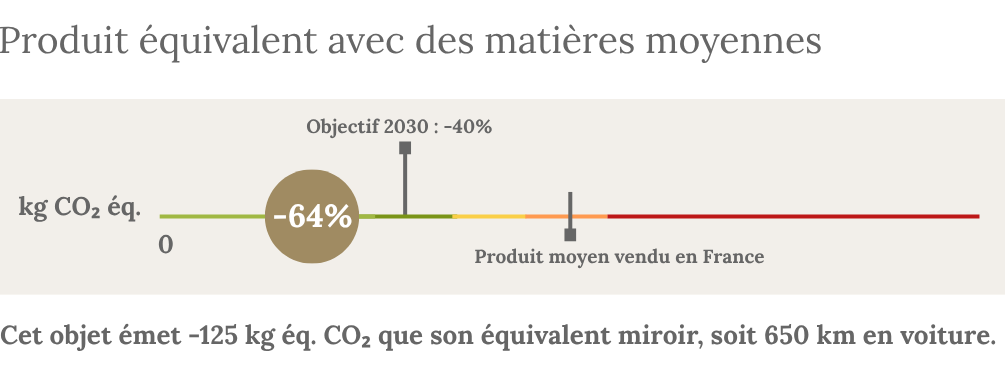
This is 40% less than the average linen duvet cover sold on the French market, and 64% less than an average duvet cover of all materials.
This performance is explained by several factors:
- A local, low-emission raw material, flax, grown without irrigation and processed close to the making site.
- 100% French making and a 100% European value chain, which limits transport and supports regional expertise.
- Low-energy dyeing and making processes, rigorously selected for their environmental control.
- Proven durability, as long-lasting linen naturally reduces its carbon footprint over time.
The life cycle analysis carried out with La Belle Empreinte shows that the majority of greenhouse gas emissions come from the initial flax processing stages.
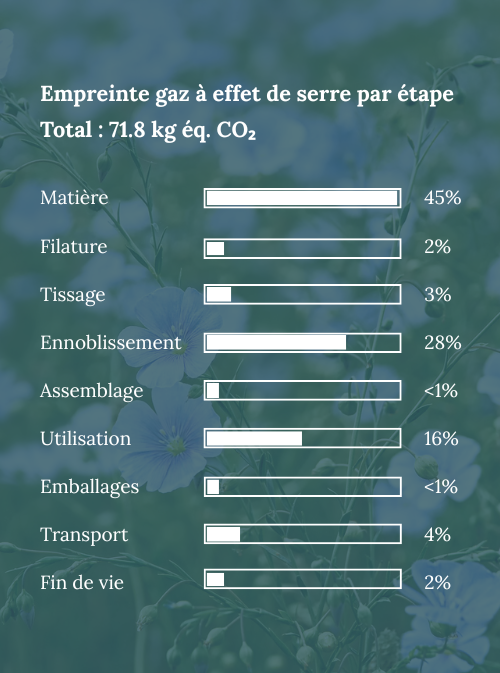
- Material (45%): this is the main source of impact. It includes flax cultivation, retting and scutching. For reference, cotton cultivation emits 3 to 4 times more greenhouse gases than flax, for the same fibre weight.
- Finishing (28%): this phase includes dyeing and fabric finishing. It uses water, heat, and synthetic products, the management of which is essential. Embrin works with committed partners to reduce these consumptions and ensure REACH compliance.
- Use (16%): this relates to washing, drying, and ironing at home throughout the product’s life. The durability of Embrin linen — longer than average — helps reduce the annual impact over its usage period.
- Weaving (3%), transport (4%), spinning (2%), end of life (2%), and assembly (<1%) account for smaller shares. Their footprint is limited thanks to local production and short supply chains, reducing unnecessary journeys and energy use. In summary, nearly three-quarters of emissions come from flax transformation stages, before the product is made. Embrin focuses its reduction efforts on these levers — improving dyeing processes, choosing low-impact yarns, and optimising logistics.
Impact on water
The environmental analysis carried out with La Belle Empreinte shows that the impact of an Embrin duvet cover on aquatic environments remains limited, thanks to the very nature of flax and our responsible production choices.
Two indicators are monitored: freshwater eutrophication and blue water footprint.
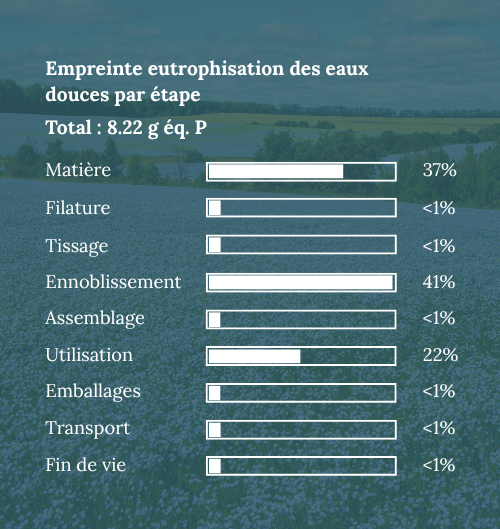
Freshwater eutrophication – 8.22 g equivalent P
Eutrophication refers to the excessive enrichment of aquatic environments with nutrients (phosphorus, nitrogen), which can cause algal blooms and water quality degradation.
- Material (37%): this impact is linked to flax cultivation and fertiliser use. However, European flax cultivation uses very few inputs compared to other textile fibres.
- Finishing (41%): this stage — including dyeing and finishing — contributes significantly to eutrophication due to aqueous effluent discharges. Our partners limit this impact through efficient treatment plants and controlled chemistry.
- Use (22%): this share comes from domestic laundry. Choosing eco-friendly detergents and washing at low temperatures can significantly reduce this impact.
- Other stages (spinning, weaving, transport, packaging, end of life) each account for less than 1% of total eutrophication.
Blue water footprint – 2,097 L
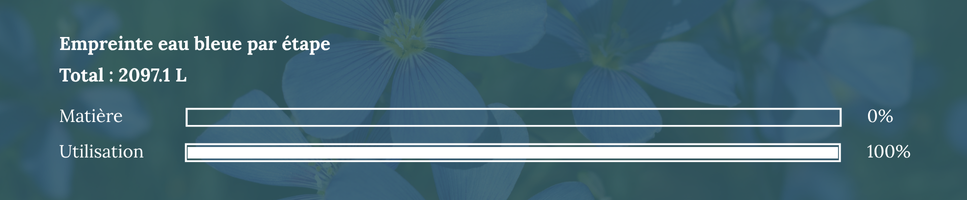
The blue water footprint measures the consumption of freshwater drawn from rivers, aquifers, or lakes.
- Material (0%): flax cultivation does not require irrigation in the European basin — a major advantage over other textile fibres such as cotton.
- Use (100%): the entire blue water footprint comes from domestic washing of the linen during its life. Thus, it is the usage stage, not manufacturing, that determines water consumption.
Thus, flax stands out for having zero water footprint at production, with the main impact linked to the user’s care of the linen.
In conclusion
The comprehensive environmental analysis conducted with La Belle Empreinte highlights the environmental performance of flax and the transformation processes used by Embrin: carbon footprint, water consumption, and impact on aquatic environments are all significantly lower than the market average.
Our results show that:
- An Embrin linen duvet cover emits 40% less CO₂ than a standard linen duvet cover, and 64% less than a duvet cover of all materials.
- The flax grown for Embrin is naturally virtuous: no irrigation, few inputs, and full use of the plant.
- The remaining impacts mainly come from finishing stages (dyeing and finishing) and domestic use (washing), which guides our improvement efforts towards these levers.
- The blue water footprint is zero at production, with most water consumption linked to care of the linen during its life.
These results confirm that French flax, processed and made locally, is one of the most sustainable fibres in the textile world.
At Embrin, we are committed to continuous improvement: working with ever more responsible partners, optimising our processes, and supporting our customers towards more considered and mindful use of home linen.
Because a truly sustainable product is one that respects nature, craftsmanship, and time.