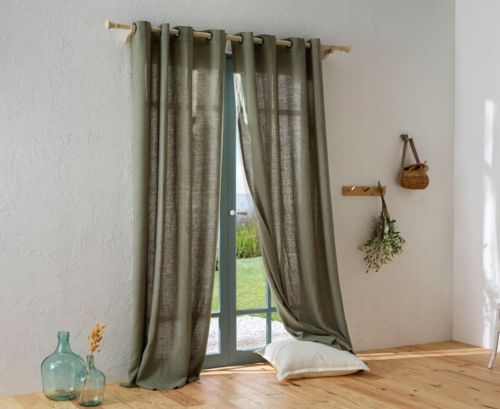
Linen Curtains: Transforming the Light in a Room
In interior design, light changes everything—even before the furniture, even before the colour of the walls. An autumn morning in Normandy doesn’t illuminate a room in the same way as a July afternoon. And yet, we rarely choose our curtains with this in mind.
We look at the colour, the drape, how it matches the sofa or the bed linen. As for the light, we only discover its effect once the curtains are hung.
At EMBRIN, we see curtains differently. More as a gentle filter, a way of letting daylight in without ever allowing it to overwhelm the room.
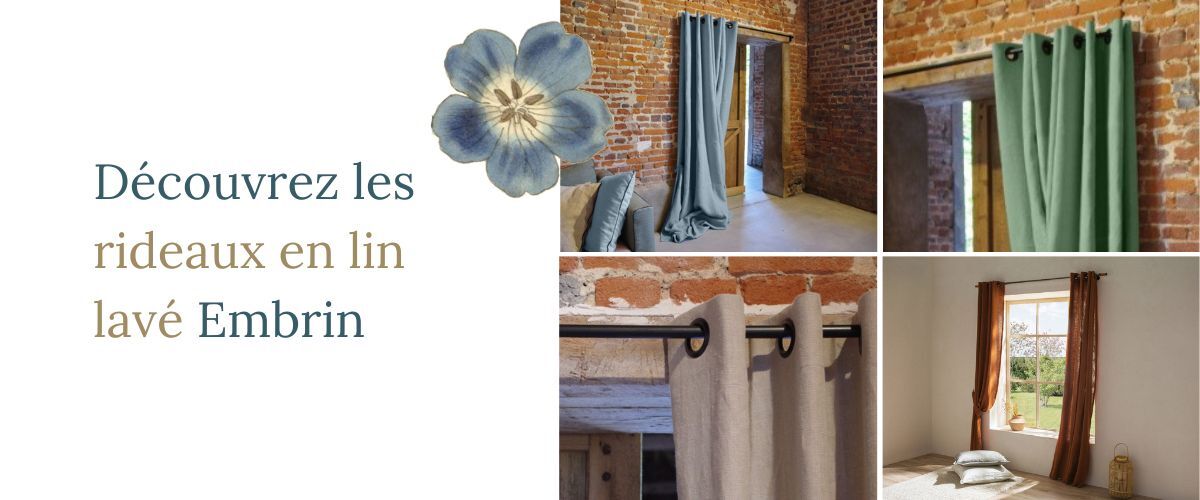
How does linen filter light differently from other fabrics?
Linen is not a smooth fabric. Within the fibre, it retains small irregularities, a result of its weave. This is precisely what makes all the difference with light: it doesn’t pass straight through linen; it diffuses, it breaks up a little, it softens.
The result is unlike any other material. A light that is slightly veiled, never harsh, shifting in intensity with the time of day and the season, but never becoming aggressive.
Which type of linen curtain to choose depending on the light you want?
At Embrin, two product families each meet a different need for light.
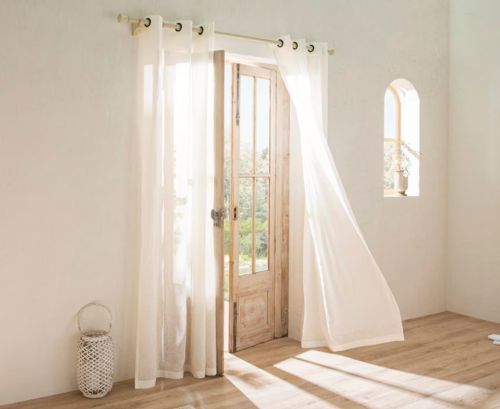
Linen voile, for almost bare light
The lighter of the two, the linen voile, allows you to glimpse the outside. The room remains bright, daylight is still present, simply softened. Ideal for a living room, a kitchen, and anywhere clarity matters as much as privacy.
This is the case with our washed linen voile Ficelle, designed to let the light in while dressing the window. The entire range, created in light and natural shades, can be found among our linen voiles.
Linen curtain, for a more substantial fabric
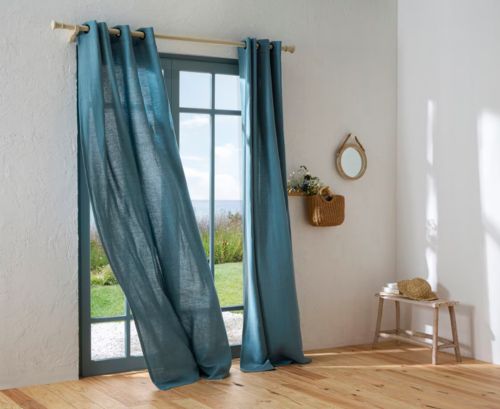
Denser than voile, the linen curtain is thicker, the light is truly subdued. Our linen curtains reach 310 g/m², for a drape with substance that never loses the natural texture of the fibre.
Once drawn, the curtains create a cosier, more enveloping atmosphere. This comes close to a blackout effect, without the need for a lining, resulting in a more natural and elegant look.
Questions about choosing a lining, curtain headings, or the best eyelets? See the complete EMBRIN curtain guide.
Why does the colour of linen also change the light in a room?
Weight isn’t everything. The shade of the linen plays just as important a role, so it’s a criterion not to overlook when choosing your curtains.
An ecru or light linen lets in light almost as it is, barely filtered, with a warmth that remains cosy and enveloping. A linen in deeper shades absorbs more light than it lets through, creating a cosier, more intimate atmosphere.
At EMBRIN, our shades are inspired directly by the Normandy landscape, and each tells a different story once hung at the window.
Let’s take the example of two grey curtains from our range.
- The washed linen curtain Gris Caviar, deep and intense, absorbs more daylight for a cosier, almost enveloping mood.
- The washed linen curtain Gris Galet, lighter, allows a gentle, diffused light to filter through, like a veiled sky over the Normandy coast.
Two shades, two different qualities of light in the same room, depending on your choice.
Can linen be used for blackout curtains?
Linen, even in its heaviest weights or deepest shades, always allows a little daylight through. That’s its nature, and we won’t claim otherwise. To address this, at EMBRIN we offer made-to-measure curtain making.
For a bedroom that needs complete darkness, linen can be paired with a lining designed for this purpose. The curtain retains its drape, texture, colour and unique light during the day, and the lining takes over at night.
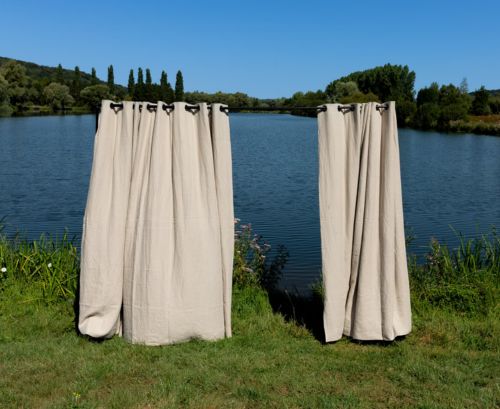
Which linen curtain to choose depending on your room’s orientation
A south-facing room doesn’t have the same needs as a north-facing one. In Normandy, where the sky changes faster than anywhere else, this question arises almost daily.
- A south-facing room will benefit from a denser linen or a deeper shade, such as the Bleu Outremer curtain, to avoid the direct glare of summer afternoons.
- A north-facing room is best suited to a lightweight, light-coloured linen, such as the washed linen curtain Ficelle, which won’t block the little light available.
- A west-facing room, where the sun is low at the end of the day, is well matched with a shade like Gris Galet, enough to soften the light without darkening the space.
Which colour to choose to visually enlarge a room?

Light shades (cream, ficelle, optic white, gris galet…) reflect more light and tend to visually enlarge the room.
If the curtain is close in colour to the wall, the effect is even stronger: there’s less visual break and the eye perceives a more continuous space.
Conversely, dark or very deep shades (bleu outremer, vert pin, gris caviar…) absorb more light and create a stronger contrast.
They may give the impression that the room is smaller, but also much warmer, cosier and more sophisticated.
There is, however, an interesting nuance with linen curtains: a strong colour does not necessarily make the room feel heavier if the fabric still lets some light through. The texture of linen and the way light plays across the material avoid the “wall” effect you might get from velvet or a fully opaque fabric.
Another important point: to create a sense of height, the way you hang your curtains often matters more than the colour. Curtains installed close to the ceiling and falling to the floor dramatically elongate the room.
In summary: which linen curtain for which light?
A linen curtain doesn’t try to dominate a room. It lets daylight in, in its own way—gently filtered, sometimes tinted, never fixed.
The weight determines the intensity of the light, the shade gives it its colour, and the room’s orientation suggests which to choose. Three simple criteria for a result that changes with the hours and the seasons.
Perhaps that’s why we love linen so much: because it remains a raw material, beautiful in its natural state, without artifice.
Keen to bring this light into your home? Discover our collection of Normandy linen curtains.