
How are Embrin colours born?
The grey of flint on longhouses, the blue of shutters in the Pays d’Auge, the deep green of foliage after the rain… In Normandy, colour is everywhere.
It is from these landscapes, but also from the houses, gardens and little details of local architecture that Embrin draws its inspiration.
But between a colour glimpsed along a country lane and the shade of a linen sheet, how does it happen? How does a colour idea become a true shade for household linen? Here’s a look behind the scenes of the process.
Household linen colours inspired by Normandy.
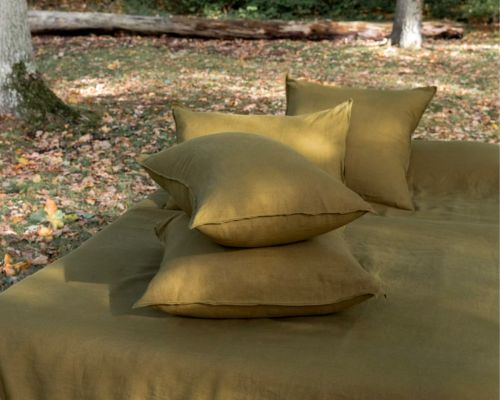 Today, the bed linen collection features around thirty shades. Gentle or deep, natural or bolder colours, which can be mixed and matched.
Some directly recall the Normandy landscape: Forest Green evokes dense foliage, Horizon Blue the light of sky and sea, while the natural linen shades echo the raw materials and agricultural scenery.
Others are more inspired by local architecture. In Normandy, the blue woodwork of traditional houses, especially in the Pays d’Auge or along the coast, offers a characteristic contrast with the wattle and daub, timber frames or brick.
How does a colour become an Embrin shade?
A palette designed to coordinate
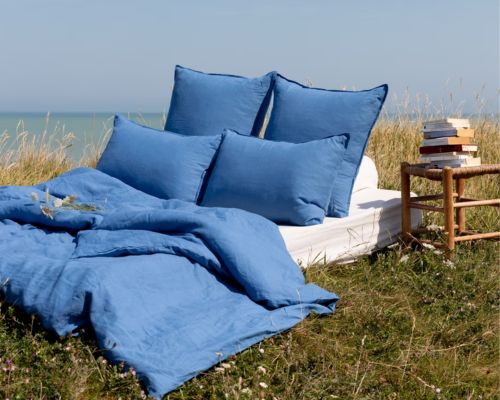 A new colour is never born alone. Even before considering its hue, we look at the existing palette. What already exists in our workshop? Which shades already work beautifully? What combinations would we like to offer? What colours do our customers request?
The aim is to be able to put together a bed set without having to choose every element in the same colour. A fitted sheet should pair with an existing duvet cover, a pillowcase with a bolster.
So the creation of a new colour also begins with this practical question: how will it live alongside those that already exist?
Paint trials
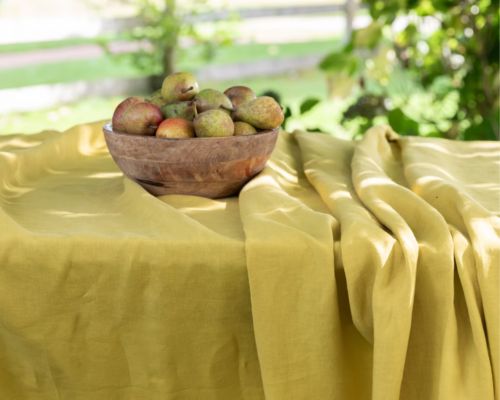 Bringing a new shade to life is Marie’s work, who has been with us for several years and is a specialist in dyes, especially plant-based ones. Her eye is invaluable in creating our colour ranges. In practice, it always begins with manual creation, with paint. No digital swatches or simulation software. Her tools? White fabric, paintbrushes and gouache paint.
Marie makes several trials to vary the hue, depth or intensity of the colour. These small samples allow us to visualise the different possibilities and compare the shades.
It’s a deceptively simple step, but one that requires an experienced eye. Because a colour on a screen, on paper or on a piece of linen never tells quite the same story.
Once the hue is approved, we move on to the next stage: dyeing the linen on a larger scale.
Collaboration with the dyer
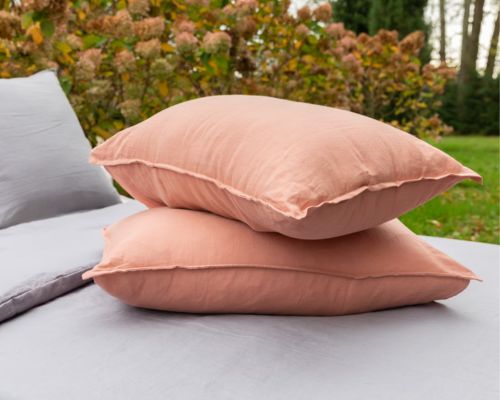 Once the shade is approved on our samples, it’s over to the dyer. Because between a small piece of hand-painted fabric and several hundred metres of linen destined to become household linen, there is of course a vital step: reproducing the colour on a larger scale.
We send our sample to the dyer with all the necessary instructions. Using this reference, the dyer makes their own trials to achieve the desired shade on linen.
This stage requires several adjustments. The colour does not react in exactly the same way depending on the material, its treatment or the dye bath. So you have to test, compare, adjust… until you get as close as possible to the shade imagined at the outset.
For the Natural and Chalk shades, no dye is used. Natural is the raw colour of the flax fibre. It may vary slightly depending on the harvest and the batches of flax used, which gives it a special beauty and uniqueness. Chalk is obtained by bleaching the fibres with hydrogen peroxide.
Focus: OEKO-TEX® and REACH – standards governing dyeing
Once the colour is chosen, we send our sample to one of our dyers. Their task: to reproduce the shade on our linen, on a larger scale.
But there’s no question of ignoring the standards that govern dyeing. Our dyers work to a precise set of specifications, in particular to meet the requirements of OEKO-TEX® certification and the European REACH regulation.
OEKO-TEX® in particular regulates the presence of undesirable substances in textiles. REACH, meanwhile, is the European regulation that governs the use and marketing of chemical substances, in order to limit risks to human health and the environment.
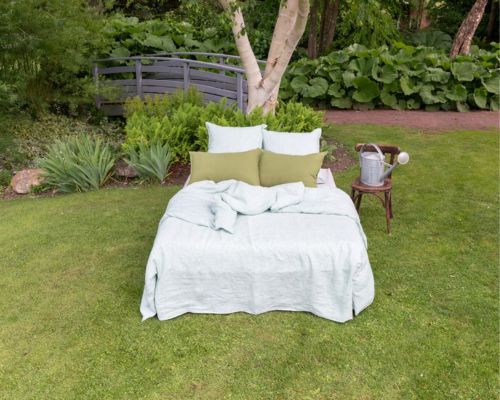 The dyer then makes several trials until the desired shade is achieved, in compliance with these standards. We receive the samples, compare them to our reference colour and approve the final shade before it enters the collection.
From trials to final approval
When the trials arrive, we compare the new shades with our reference sample and with the colours already in the collection. Is it too pale? Not deep enough? Each nuance is observed with care.
We then work with the dyer to refine the recipe until the desired colour is achieved.
This stage may seem painstaking, but it is essential. A colour must of course be beautiful on its own, but also find its natural place among the others.
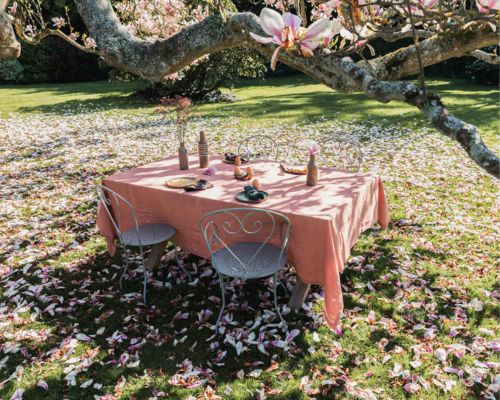 It is this precise work that ensures a coherent palette in our household linen, season after season, and allows you to easily combine a duvet cover with sheets, a pillowcase or a fitted sheet in different shades.
From the Normandy landscape to household linen
Behind every Embrin colour, there are several perspectives: the way we look at the landscapes around us, Marie’s expertise in dyeing, and then the dyer who brings the shade to life on linen.
The result is not an exact reproduction of a landscape. It is more about capturing an impression: the light of a Normandy sky, the blue of old woodwork, the green of foliage, the warmth of wood or the softness of a natural shade.
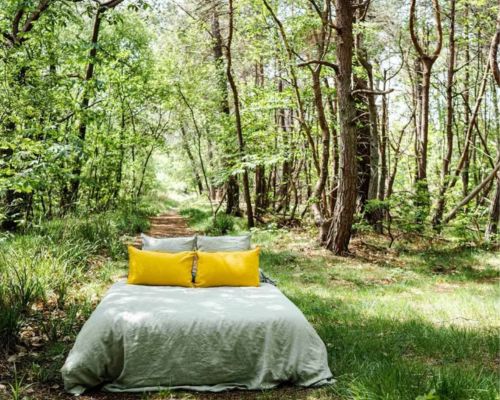 This also explains the importance given to colour in our linen collection. They are designed to live together, blend and evolve with the seasons and with interiors.
And what if your favourite colour was already in Normandy?
Midnight Blue, Forest Green, Natural Linen, Terracotta… behind every shade, there’s an inspiration, trials, and a little patience to find just the right hue.
The palette continues to grow, shaped by Normandy’s landscapes, desires and the combinations imagined around linen.
So, which Embrin colour most evokes Normandy for you?